
Alopecia: Definition and Main Clinical Categories
Alopecia refers to the reduction or loss of hair, which can be caused by various factors. There are two main categories:
Scarring Alopecia
Caused by the atrophy of the hair follicles, it affects around 3% of people with hair loss. The loss is permanent, as the follicles are replaced by scar tissue. Examples include lichen planopilaris and discoid lupus erythematosus.
Non-Scarring Alopecia
Due to processes that slow down or interrupt hair growth without permanently damaging the follicles, it affects around 70% of people with temporary loss. Once the triggering cause has been identified, the hair tends to grow back within a few months.
Main Types of Alopecia
Androgenetic Alopecia
It affects around 80% of men and 50% of women. It is caused by genetic predisposition and sensitivity to androgen hormones.
In men: it manifests as thinning from the fronto-temporal area to the crown, creating the classic "receding hairline". It can begin as early as age 25.
In women: the thinning is more diffuse without causing complete baldness. In recent years it has also been observed in many teenage girls.
Alopecia Areata
An autoimmune disease that causes complete hair loss in patches. The immune system attacks the hair follicles. In some cases the hair grows back spontaneously, in others treatment with corticosteroids or JAK inhibitors is needed.
Telogen Effluvium
Caused by physical or emotional stress, it occurs when many follicles enter the resting phase prematurely. The shedding is temporary and the hair grows back once the triggering factor has been resolved.
Traction Alopecia
It results from prolonged tension caused by hairstyles that are too tight. To prevent it, it is advisable to alternate styles and keep the hair loose or under less tension.
Trichological Examination at Centro Eudermia
The trichological examination is a complete specialist assessment of the scalp and hair. At Centro Eudermia in Cagliari, every trichological examination includes:
- Complete medical history of your clinical and family background and of previous treatments
- Clinical examination of the scalp and hair
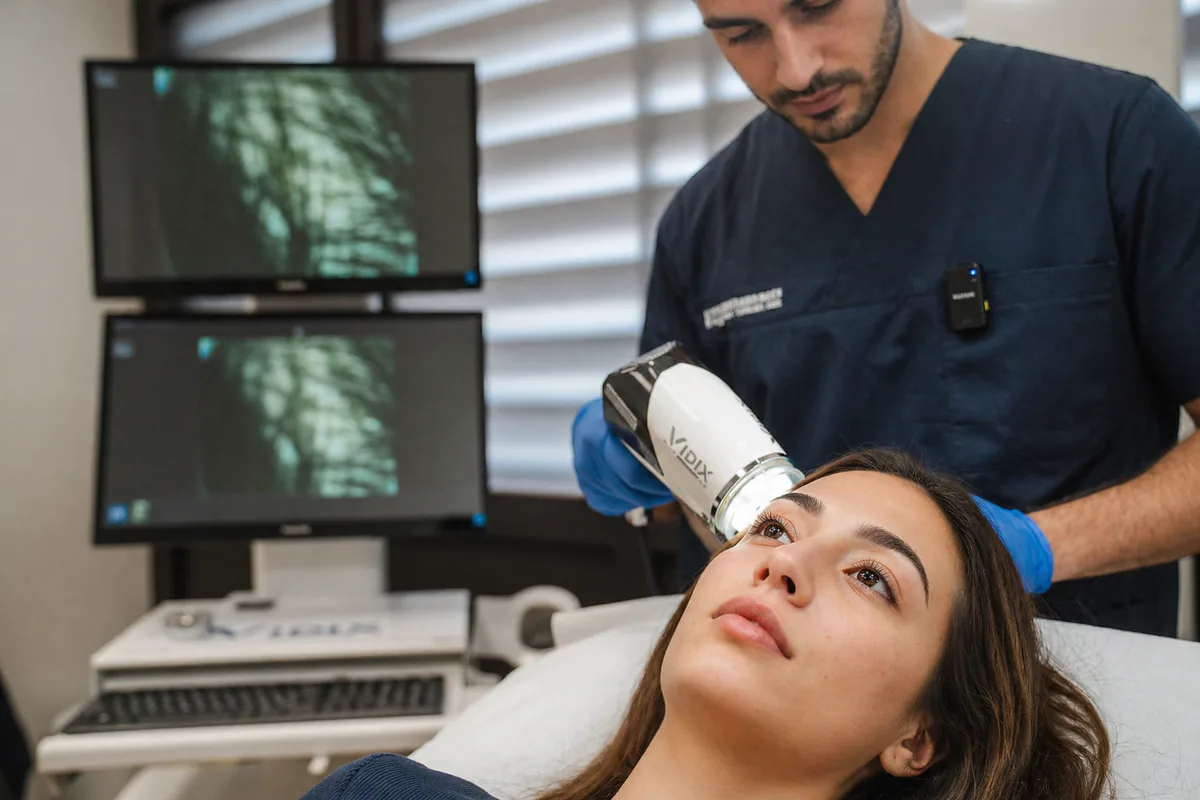
- Digital trichoscopy with VIDIX for microscopic analysis of the hair follicles
- Precise hair count per square centimetre
- Assessment of follicular miniaturisation, the hallmark of androgenetic alopecia
- Differential diagnosis between the various forms of alopecia
- Personalised treatment plan explained in detail
- Digital photographic documentation for comparison over time
VIDIX technology makes it possible to objectively monitor the effectiveness of the treatment over time: at each subsequent check-up, the current images are compared with the previous ones to identify even the smallest variations, invisible to the naked eye.
Diagnosis of Alopecia
Diagnosis requires a Dermatologist with advanced equipment such as the Vidix Digital Videodermatoscope, which makes it possible to:
- Count the number of hairs per square centimetre
- Analyse the density and condition of the hair follicles
- Monitor the results of treatments over time
The dermatologist makes a complete diagnosis through clinical examination, medical history, blood tests and trichoscopy of the scalp.
Available Treatments
There are several treatments for alopecia, each indicated for specific types and degrees of hair loss. Centro Eudermia assesses each case individually and indicates the most suitable path, performing some treatments directly and referring the patient to specialist referral centres for others when necessary.
Topical and Oral Medications
- Minoxidil: stimulates regrowth by increasing thickness and density. Results visible after 4 months.
- Finasteride: an oral and topical medication, very effective especially in men.
- Corticosteroids: for alopecia areata, administered via foams or local injections.
- Hair filler: based on peptides and hyaluronic acid.
- PRP (Platelet-Rich Plasma): injection of plasma to stimulate the follicles and improve density.
Surgical Treatments
Hair transplant: indicated for advanced stages, it consists of taking follicles from the back of the head and re-implanting them in the thinning areas.
What to Expect from Treatment
The response takes time and consistency. In most cases, the first signs of improvement are noticeable after 4 months from the start of therapy, while the maximum benefit is reached between 6 and 12 months. VIDIX technology makes it possible to document even small advances not visible to the naked eye, giving the patient objective evidence of the effectiveness of the treatment.
For some forms, such as androgenetic alopecia, maintaining the results requires continuous long-term therapy. In other cases, such as telogen effluvium, once the triggering cause has been resolved the therapy can be suspended.
When to Consult the Dermatologist
We recommend seeing the specialist when you notice shedding above the norm (roughly more than 80-100 hairs a day for prolonged periods), visible thinning, the appearance of patches without hair, a progressively receding hairline or a change in hair thickness. Early diagnosis is essential: the sooner you act, the greater the chances of achieving satisfactory results.
Why Choose Centro Eudermia
Centro Eudermia is a leading centre for alopecia thanks to Dr. Alessandra Guicciardi, with over 30 years of experience. The centre has the Vidix Videodermatoscope for precise diagnoses and treatment monitoring. All treatments are completely painless.