
Atopic Dermatitis
Specialist diagnosis and care for adults and children
Atopic dermatitis should not dictate your life, or the lives of those you love. With over three decades of experience in treating atopic eczema in adults and children, we offer personalised therapies to control itching and flare-ups and to improve quality of life.
- Atopic dermatitis specialists for over 30 years
- Personalised therapies for adults and children
- Lasting control of itching and symptoms
- Family education for daily management
The Eudermia Approach
Your atopic dermatitis care journey, in 4 steps
Not a standard protocol, but a personalised method that adapts every stage to the individual patient, from the specialist assessment to follow-up over time.
Specialist assessment
Detailed personal and family history, complete clinical examination of the lesions, severity assessment (SCORAD, EASI), identification of specific triggers. Allergy testing where indicated.
Personalised treatment plan
Therapy defined according to age, severity, location of the lesions and the triggers identified. Never a standard protocol: every patient receives a plan designed around their individual needs.
Active treatment and maintenance
A combination of topical therapies (emollients, corticosteroids of appropriate potency, calcineurin inhibitors), systemic therapy where required for severe forms, and education in daily home management.
Follow-up and flare-up prevention
Regular check-ups to adjust the therapy, assess the clinical response and prevent flare-ups. Managing atopic dermatitis is an ongoing journey, not a single intervention.
The Different Stages of Life
Atopic dermatitis at the different stages of life
Atopic dermatitis presents differently depending on age. The treatment plan is adapted to the specific profile of the patient.
Atopic dermatitis in infants (0-2 years)
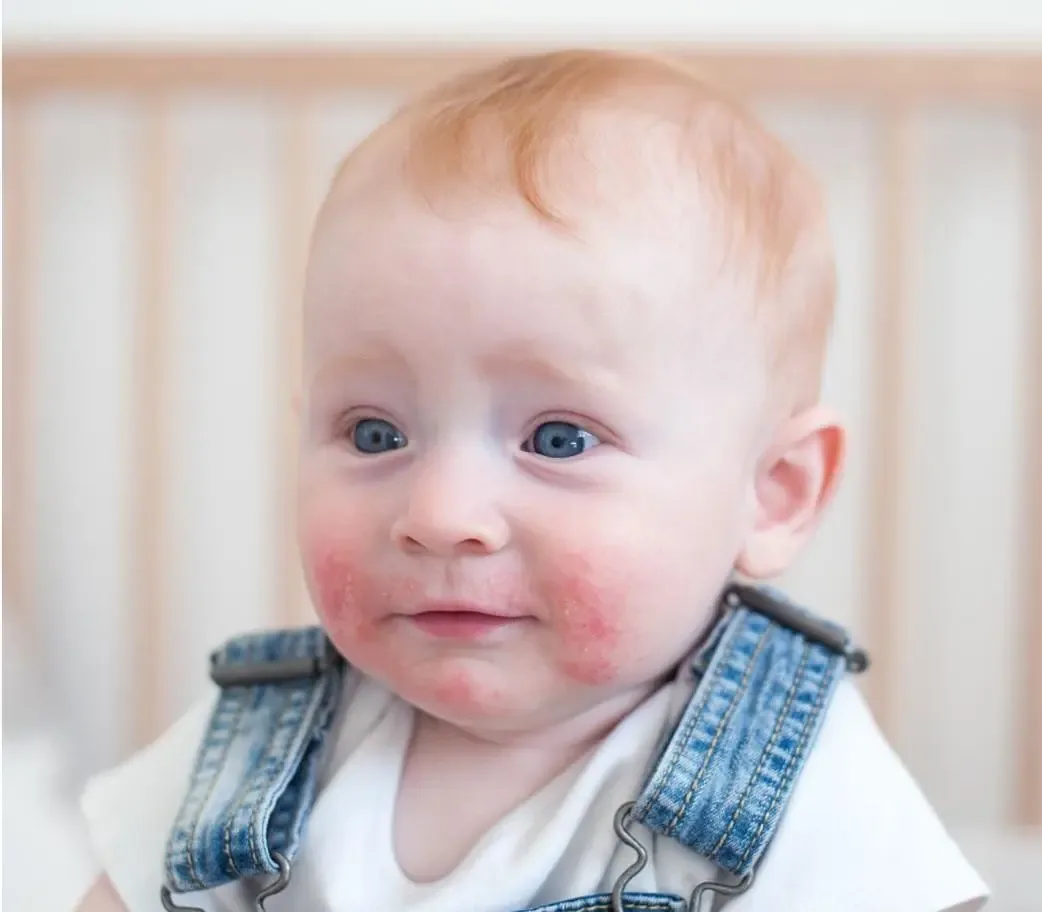
Early onset, often within the first 6 months. Typical location on the face, scalp and extensor surfaces. Symptoms: redness, vesicles, crusting, intense itching. Possible bacterial infections from scratching. A significant impact on family sleep.
Atopic dermatitis in children (2-12 years)
A change in location: the creases of the elbows and knees, wrists, ankles, neck. Chronic forms with thickening of the skin (lichenification). Possible difficulties at school due to the itching, plus social and isolation issues. The need for specific management routines.
Atopic dermatitis in adults
Forms that persist from childhood or that begin in adulthood. Locations: hands, neck, eyelids, flexural areas. Occupational forms (hairdressers, nurses, cleaning staff). Comorbidities: asthma, allergic rhinitis, food allergies. An impact on work, sleep and quality of life.
Available Therapies
The treatments available at Centro Eudermia
A complete therapeutic range, chosen and calibrated to the characteristics of the individual clinical case.
Emollients and hydration
The foundation of every treatment. Daily application of specific emollients to restore the compromised skin barrier. These are not simple moisturisers: they are products formulated specifically for atopic skin.
Topical corticosteroids
First-line treatment for flare-ups. Used at a potency appropriate to the age and the area being treated. When used correctly under medical supervision, they are safe and effective even in children.
Calcineurin inhibitors
Tacrolimus and pimecrolimus: alternatives to corticosteroids, particularly indicated for delicate areas (face, eyelids, skin folds) and for prolonged use. They allow the condition to be controlled without the long-term side effects of corticosteroids.
Antihistamines for itching
For the control of itching, particularly at night. Molecules suited to the age and specific profile of the patient are chosen.
Systemic therapies (severe forms)
For severe and resistant forms: systemic corticosteroids for acute phases, immunosuppressants (ciclosporin, methotrexate), antibiotics for infections. The new-generation biologic drugs are subject to hospital-only prescription.
Education in home management
A fundamental component: the correct application of topical therapies, a hydration routine, the identification and avoidance of triggers, the management of acute flare-ups. Educating the patient and the family is an integral part of the care.
Signs Not to Ignore
When to consult a dermatologist
It is advisable to consult a specialist dermatologist when:
- The symptoms interfere with daily life, sleep, work or school
- Over-the-counter treatments produce no improvement after 1-2 weeks
- Recurrent skin infections appear (yellow crusts, pustules)
- Atopic dermatitis is suspected as a diagnosis for the first time
- The symptoms suddenly worsen despite ongoing therapy
- Warning signs appear: erythroderma (more than 90% of the body surface involved), fever, general malaise, swollen lymph nodes
An early specialist assessment makes it possible to set up the most suitable therapy and to prevent longer-term complications.
Related Forms
Neurodermatitis and other forms of chronic eczema
Neurodermatitis (also called lichen simplex chronicus) is a form of chronic eczema that shares several characteristics with atopic dermatitis, while being a clinically distinct condition. It presents as a localised thickening of the skin (lichenification) caused by repetitive prolonged scratching, often secondary to an initial itch of another origin — pre-existing atopic dermatitis, contact dermatitis, psychogenic itching or stress.
The most commonly involved areas are the nape of the neck, wrists, ankles, the backs of the hands and the anogenital region. The skin appears thickened, leathery, with accentuation of the natural skin lines, sometimes hyperpigmented. The itching fuels the scratching, the scratching worsens the lichenification: this creates the so-called "itch-scratch cycle" that maintains the condition.
Where neurodermatitis is present, the treatment approach is similar to that for atopic dermatitis, but with a few key differences in focus: breaking the itch-scratch cycle (with occlusive dressings if necessary), topical corticosteroids of a potency appropriate to the area, stress management where it is a contributing factor, and the identification of any underlying causes of the initial itching.
The specialist assessment makes it possible to correctly distinguish neurodermatitis, primary atopic dermatitis and other forms of eczema, setting up a targeted therapy. If you suspect one of these conditions, a dermatological consultation makes it possible to clarify the diagnosis and to begin a personalised course of care.
The Eudermia Difference
Why a specialist dermatological approach makes the difference for atopic dermatitis
Decades of focused experience
Over three decades of experience dedicated, among other areas, to the treatment of atopic dermatitis. Thousands of patients followed, from mild paediatric forms to severe forms in adulthood.
An approach tailored to age
Atopic dermatitis presents differently in infants, children and adults. Our experience allows us to calibrate the therapy according to age, the area of the body, the severity and the specific triggers of each patient.
Advanced diagnostics
Patch testing to identify contact allergens, prick testing for inhalant allergies, measurement of specific IgE where needed. Photographic documentation of the progression to objectively assess the response to therapy.
Family and patient education
Particular attention to educating the patient and their family. Daily home management is crucial to therapeutic success: we explain how to apply the therapies, identify the triggers and manage flare-ups.
Frequently asked questions about atopic dermatitis
Related Conditions
Related skin conditions with similar chronic inflammatory features.
4.9 / 5 on Google
348 verified reviews
Reviews translated from the original Italian
“I waited 4 months before leaving this review. I wanted to be sure I had truly solved my problem. I suffered for 2 years and was seen by dermatologists who turned out to be useless, as they never gave me the right treatment — only a waste of time and money while my condition got w…”
Your First Step
Start your journey towards controlling atopic dermatitis
The first visit is dedicated to a complete assessment of your situation and to defining a personalised treatment plan. No commitment: we explain the available options and you decide whether to proceed.
Results may vary depending on the individual clinical case. The information on this page is for general information purposes only and does not replace the advice of a specialist physician.